Types Of Work Process In Sap Basis

SAP Business Workflow - Introduction. In SAP system, Business Workflows are used to execute business processes in applications. Workflows are a key component of SAP system wherein they help design the business processes - it can be a simple release or a complex repeated business process such as creating a material master, etc. With the help of SAP Basis, different SAP modules like Finance Accounting, Production Planning, Sales and Distribution, SAP EWM and other modules can integrate and communicate with each other. SAP Basis supports the installation and configuration of SAP applications on different operating systems like Windows, Unix, AS/400, etc. On the transaction code RZ10, find parameter rdisp/nobtcwp and change to the desired value. A restart of SAP system is needed to apply the changes. You can also doing the same steps for decreasing the background work process. The SAP profile parameter that controls the number of background work processes per instance is rdisp /wpnobtc. The background process can be further organized into different types of job queues based on the priorities needed in the particular installation. Background jobs are very important in the daily management and operation of the system. SAP runs eight different types of processes on Application Server. How many actual processes would be run for each type is dictated by SAP instance profiles (which we will talk about next). These SAP process are sometimes references as DVEBMSG, where. D – dial work process. V – update work processes. V1 – high priority update.
Even though the processes are unique at OS level SAP differentiated between the work processes based on the nature of work.The process are determined by the instance name DVEBMGS<Instance_No>
For Dialogue instances the work process will be denoted as D01, D02....
D - Dialogue
V - Update
E - Enqueue
B - Back ground
M - Message
G - Gateway
S - Spool
DVEBMGS is only available in the Central instance.
D01 to DN-1 for Dialogue instances.
Central Instance DVEBMGS - 2112111
It hosts all the process and their will be only one central instance in the entire system.
1. DIALOGUE 'D'
It is only the process which communicates interactively with the users. There should be at least 2 Dialogue work process per instance. Dialogue work process initiates Update, Background and Spool.
2. UPDATE 'V'
It is used to update the transactions in the database. It is initiated by Dialogue process. There should be at least 1 Update in the entire system. It is also recommended to have an update process for every 5 Dialogue.
3. ENQUEUE 'E'
It is used to provide locks for the records that are going to be updated. It ensures consistency for updates. There will be only 1 Enqueue configured in the system during the installation. It is possible to have more than one enqueue provided they are installed or configured on the central instance.
4. BACKGROUND 'B'
The tasks which are expensive or time consuming are scheduled to run in the background mode non-interactively. There should be at least 2 background work process in the system
5. MESSAGE 'M'
There should be only 1 message server in the entire R/3 system. It is used to manage all the dispatchers. It is used to load balance the requests to identify the least loaded dispatcher.
It is also used to provide locks to the request that are coming from Dialogue instances.
6. GATEWAY 'G'
It is used to provide a means of communication with SAP and NON-SAP systems. There will be only 1 gateway for each instance.
7. SPOOL 'S'
It is used to print the documents to a printer or output to a fax machine etc. There should be at least 1 Spool process in the entire system. It is also possible to configure more spool process depending on the print/spool volume.
DVEBMGS00
Dialogue - Interactive - 2 per instance - Initiate update, spool and btc (background)
Sap Basis Administrator
Update - Non-Interactive - 1 per system - Initiated by dialogue
Enqueue - Provides consistency for updates - 1 per system and can be increased
Depending upon the update requests but needs to increase only on the
Central instance for optimal performance.
Background - Non-Interactive - 2 per system - Initiated by dialogue, Time consuming And long running jobs are scheduled to run in the background mode.
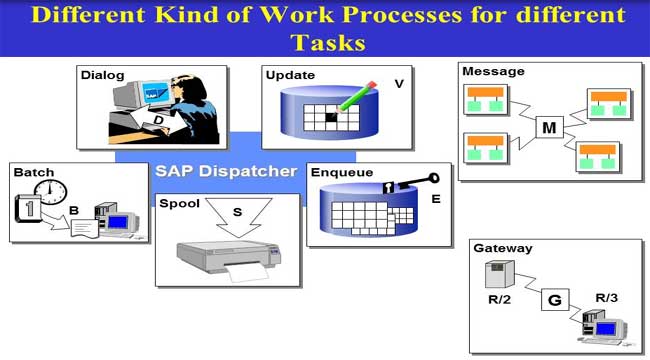
Message - Used during load balancing. It also procures lock from enqueue server To serve the requests that is coming from dialogue instances. Only 1 Per system.
Gateway - It provides an interface to communicate between SAP and NON-SAP Systems. 1 Gateway per instance.
Sap Basis Tutorial
Spool - It is only the process that outputs the documents to printers, fax etc. It is initialized by Dialogue and BTC. At least 1 spool per system.
Skip to end of metadataGo to start of metadataWork process:
1. Dialog work process for online users.
2. Background work process for background users.
3. Update work process upd and up2(Critical and less critical)
4. Spool work process (printer)
5. En queue work process ( leader)
Dialog Work process (DIA):
· Dialog work process is responsible for online job.
· Each Dialog work process is allotted with specific time for executing the given command.
· All interactive request (SAPGUI) will be processed by Dialog work process.
· We can request the processing time of a dialog work process within the help of profile parameter (t code is RZ10)
· Each work process required 50-60 MB of memory.
· Work process count: we need to modifying profile parameter “rdisp/wp_no_dia”.
· Dialog timeout: we need to modifying profile parameter “rdisp/max_wprun_time”. Default is 600 seconds
Background Work process (BTC):
·
According to SAP Standards each dialogue work process can hold 10 users. But one at a time.
· At least two dialogue work process per instance.
· You can define any number of background work process jobs. All this jobs will be executed one by one with this background work process.
· Each background work process will process on background job at a time. While processing a background job.
· The background work process process will internally use one or more than one dialog work process. Background jobs are defined in 3 classes.
*i) *Class A (High priority)
*ii) *Class B (Medium priority)
*iii) *Class C (Low priority)
· The parameter for background work process are “rdisp/wp_no_btc”
Spool Workprocess (SPO):
· It is meant for print related tasks in sap environment.
· There will be at least one spool process for whole SAP system.
· The parameter for Spool work process is “rdisp/wp_no_spo”
Update Work process (upd and up2):
· These are 2 types Critical and less Critical
· These are represented as upd and up2 respectively and also as V1 and V2 respectively.
· Upd is synchronous update (offline) Ex: E-mail
Types Of Work Process In Sap Basis Costing
· Upd2 is synchronous update (online) EX: ATM
· Update work process is nothing but save data in database.
· The parameter for update work process is “rdisp/wp_no_vb”
En queue Work process:
· En queue is responsible for lock management and to send request in queue.
· En queue resides in central instance.
· This will avoid modifying a particular table by two different users parallel. There are two major types of Locks.
i) Shared Lock: When users “A” then all other users can read the table “A”, but cannot modify it until user “A” finished it.
ii) Exclusive Lock (X): When User “A” access table “A” and nobody can also read or dispatching “A” until user “A” finished it. All this information will be written to lock table that was created in Central Instance shared memory are at the time of Instance start. This size of this table is 4 MB by default and the maximum size you can define is 100 MB.
· When locks are occurring in peak time there are may be lock overflow errors of you see this error regularly.
· These are mush change size of lock table. There will be also on En queue work process for whole SAP system it can be changed to more than one when SAP support recommends.
· The parameter for En queue work process is “rdisp/wp_no_enq”
INSTANCE:
· Group of R/s services (Dialog, background, Update, En queue and Spool).
Dialog Instance:
Ø It all the Work process types are the dialog in application server then it is called as Dialog instance.
CENTRAL INSTANCE:
Ø A Central Instance comprises all the four types of Work process, Gateway and Message services.
Ø Gateway is common for the entire Instance.
Ø Message Service only on in the Central Instance.
DATABASE INSTANCE:
Ø The moment we load database Instance we are going to get all the modules of SAP.